EU Data Act: what machine builders must do
The EU Data Act already applies. What it requires of machine builders: which machine data you must give for free, what exemptions exist and what you can charge for.
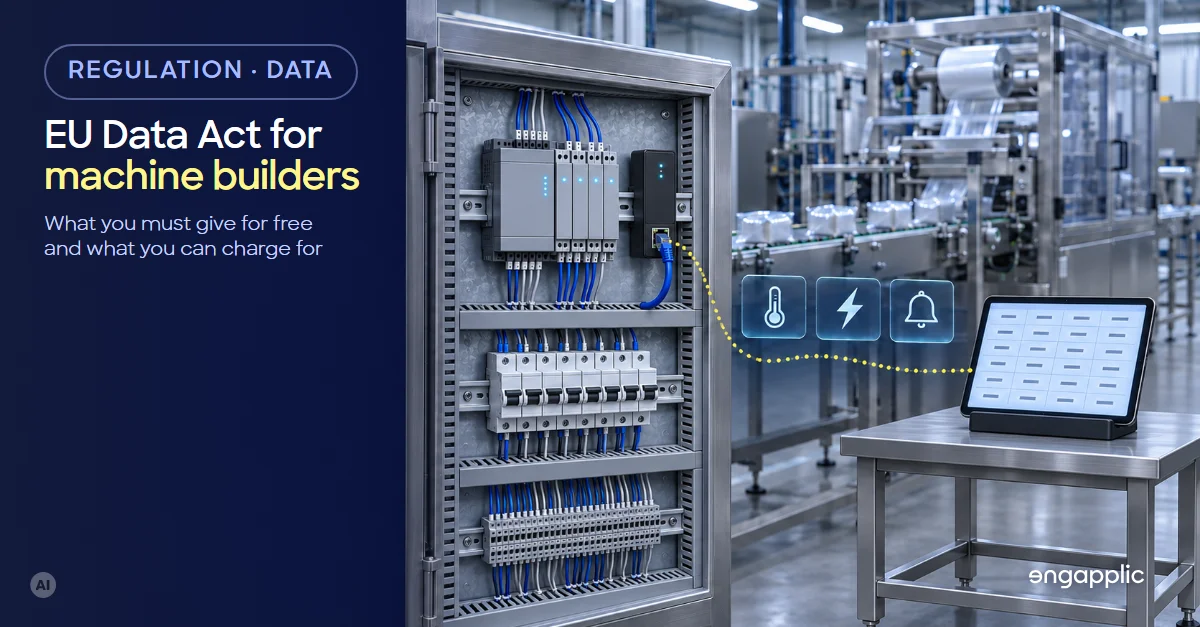
We wrote this as engineers who program machines, not as lawyers. It covers what the text says and what it means on the machine; for your own case, check with your legal adviser.
What is the EU Data Act and when does it apply?
It is an EU regulation, so it applies directly in every Member State, with no national law in between. It sets out who may use the data generated by connected products, and the European Commission lists industrial machinery among its examples.
| Date | What happens |
|---|---|
| 11 January 2024 | Enters into force |
| 12 September 2025 | Applies: right of access to the data, and information before the sale |
| 12 September 2026 | Machines placed on the market after this date, and their related services, must be designed to give access to their data |
| 12 September 2027 | The rules on unfair contract terms also reach contracts signed up to 12 September 2025 that are open-ended or expire on or after 11 January 2034 |
Source: Article 50 of the regulation.
The 2026 milestone is only the design one. A machine already installed may also have to give access, since 2025, to the data the data holder has at hand.
In November 2025 the Commission proposed changes to the Data Act, as part of the package known as the “Digital Omnibus”. As of 25 November 2026 they are still going through the legislative process and have not been adopted: this article covers the text in force.
Is my machine a “connected product”?
It is if it collects or generates data about its use or its environment and can communicate that data: over the internet, through a physical connection or through access on the machine itself. It doesn’t need to be in the cloud. A machine whose PLC¹ lets you check its alarms or operating data remotely normally fits the definition.
The regulation deals with products that are already connected. It doesn’t say that unconnected machines have to be connected.
EU Data Act and industrial IoT: which data your machine must give
The Data Act is broader: it also covers, for example, switching between cloud providers and unfair terms in contracts between companies. But what concerns industrial IoT² is in its Chapter II: the data of connected products and their “related services”. For a machine builder, three things:
- Software that acts on the machine is covered too. An app or a remote function that changes setpoints or sends commands to the machine is a related service if the machine needs it for one of its functions, or if it is connected later to add, update or adapt functions (Article 2(6)). Its data about the use of the machine must be given too. Analysis or periodic maintenance that doesn’t change how the machine works is not (Recital 17).
- The data can be given on the machine or from the cloud. Access can be direct, on the equipment itself or on a local device, or from a remote server, including the cloud (Recital 22). If the machine already sends its data to the cloud, you can give it from there; if you would rather not depend on a remote server, local access works too.
- It doesn’t make you store what the machine doesn’t put out, but what you store counts. If the machine isn’t designed to store or put out a piece of data, that data isn’t covered (Recital 20). But if you install a gateway and keep a history of measurements or alarms, that data is now at hand, and the customer can ask for it with its metadata. The diagnoses you work out from it are not covered. And if the machine logs alarms on its panel, it is worth checking whether they can be retrieved without disproportionate effort, even if they have never left the machine.
EU Data Act compliance: what does a machine builder have to do?
- Tell the customer before selling. Before the sale or rental contract is signed, the customer must be told, clearly, what data the machine generates (type, format and estimated volume), whether it generates it continuously and in real time, where it is stored and for how long, and how to access, retrieve or, where relevant, erase it.
- Give the machine’s user access to the data. If the customer can’t get it directly from the machine or the service, it is provided: free of charge, without undue delay, at the same quality the data holder has, with its metadata and in a machine-readable format. Where relevant and technically feasible, continuously and in real time.
- Share it with a third party if the customer asks. For example, with the company that maintains the machine. Unlike the customer, the third party can be asked for reasonable compensation; if it is an SME or a non-profit research organisation that meets the conditions of Article 9(4), no more than the cost of making the data available. With two limits that protect the builder: the third party can’t be a “gatekeeper”, one of the large digital platforms designated by the EU (Article 5(3)), and neither the customer nor the third party may use the data to develop a product that competes with the machine it comes from (Articles 4(10) and 6). Maintaining the machine is allowed.
- Design new machines so that access is easy. Those placed on the market after 12 September 2026, and their related services, must give access to their data by default, free of charge, easily, securely and in a machine-readable format, and directly to the user where relevant and technically feasible.
Who answers for what: the pre-sale information comes from whoever sells or rents the machine (you or your distributor). Points 2 and 3 fall on the “data holder”: whoever has the right or the obligation to use and make available the machine’s data, usually the builder or whoever provides a related service. Design falls on whoever designs and manufactures the machine or provides the service. And if you sell a related service, you also have to inform the customer before the contract: what data it generates, what you will use it for and how the customer can ask for it to be shared (Article 3(3)).
Source: Articles 3, 4, 5 and 9 of the regulation.
Does the EU Data Act apply to small companies?
For these obligations, in general, no. Those in Chapter II (access to the data and sharing it) don’t apply to data from machines manufactured or designed, or related services provided, by a micro or small enterprise (fewer than 50 people and up to 10 million euros in annual turnover or balance sheet, under the EU definition). There are two exceptions: the company has a partner or linked enterprise that isn’t micro or small, or it has been subcontracted to manufacture or design the machine or to provide the service.
Medium-sized companies get a year’s grace, under the same conditions: it doesn’t apply while they have been medium-sized for less than a year, nor to each new machine during its first year on the market. After that, it applies to medium-sized and large companies.
The exemption doesn’t cover the rest of the regulation, such as unfair terms in contracts between companies. And even if you are small, it is worth knowing: your larger customers know it, and they will start asking for their machines’ data in contracts.
Source: Article 7 of the regulation.
Which data are we talking about on a machine?
The data the machine already produces as it works, and that the data holder can reach without disproportionate effort. On a machine with a PLC, that mostly means its signals:
- temperatures, pressures and flows;
- electricity, gas or air consumption, if the machine has meters;
- alarms and stops, with their date and time;
- working hours, cycles and part counters.
It is the raw data as it comes out of the machine, or pre-processed in a simple way, with the metadata needed to interpret it, such as the time or the unit. What you work out from it with your own know-how (a model, a diagnosis of your own) is derived information, and a different matter.
How do you give access to machine data without redesigning the machine?
This is the engineering part. The PLC nearly always holds the current value of each signal; what it usually doesn’t hold is the history, and alarms with their timestamp often stay on the machine’s panel. On older machines a signal is sometimes missing, and a sensor or a meter has to be added.
- Take stock. First, what data the machine has: the PLC, the panel, the meters. Then, which of it to use in your service. The customer’s right of access doesn’t depend on that choice.
- Read it from the PLC with a gateway at the machine, over OPC UA³, Modbus or the PLC’s own protocol. The machine’s logic isn’t changed: on many machines it is enough to enable or configure the PLC’s communication; on others, variables have to be exposed or a sensor added.
- Keep the history, if you want it. We send it to the cloud; it can also stay on the machine or on a local device. The regulation asks for neither, but any history you keep must also be given if the customer asks.
- Show it on a dashboard that both you and your customer can see.
- Be able to hand it over for free. A dashboard isn’t a machine-readable format: you also need a way to download the data, such as a documented CSV⁴ file or an API⁵, with its metadata. If access has to be continuous, an occasional CSV falls short.
OPC UA and Modbus don’t give you the same thing: OPC UA can carry each signal’s name, type, timestamp and unit, if the PLC’s server has them configured; with Modbus you have to document what each register is, its unit and its scale. With either, the gateway is set up to read in read-only mode.
This is how we work at engapplic, with the most common PLCs on the market. We start with a short, fixed-price consultation to review the PLC, the panel and the data your machine has, and we build the history, alerts and dashboards with coppioT, engapplic’s no-code industrial IoT platform. coppioT isn’t a legal compliance tool: it is a way to have your machines’ data in order and in view.
What opportunity does it open, and what can you charge for?
The Data Act is usually told as an obligation. For a machine builder it is also a warning: machine data is about to start moving. If the customer hands maintenance to a third party, the builder can compete with what it knows best: how that machine works.
With the same data that has to be made accessible, you can:
- know what is wrong with the machine before sending a technician;
- warn the customer when a signal leaves its normal range;
- get ahead of failures by watching the trend of a temperature or a consumption, as we explain in predictive maintenance.
That is already a service, and you can charge for it. The line is this:
| What | Can the machine’s user be charged? |
|---|---|
| The raw and pre-processed data from their machine, with its metadata | No: free of charge |
| Optional services: the dashboard, alerts, reports, analysis, prediction | Yes, they can be charged for |
One more condition: to use the non-personal data from your customer’s machine in your service, you need to agree it with them in a contract. And you may not use it to derive insights about their economic situation, assets or production methods that could undermine their commercial position (Article 4(13)). If the data carries an operator’s name or login, it is personal data and the GDPR⁶ prevails (Article 1(5)).
Where to start
In a 15-minute call we look at one of your machines and what data you can get out of it today; if more is needed, we propose a fixed-price IoT consultancy. Tell us about your case in the form.
Further reading, on the coppioT blog: low-code vs no-code IoT platform for industry and Modbus TCP vs OPC UA.
Sources: Regulation (EU) 2023/2854 on EUR-Lex, and the European Commission’s page Data Act explained. Read on 13 and 25 November 2026.
Frequently asked questions
When does the EU Data Act apply?
It entered into force on 11 January 2024 and has applied since 12 September 2025. The obligation to design products and their related services so that they give access to their data covers those placed on the market after 12 September 2026.
Do I have to give a remote monitoring dashboard for free?
In principle, no. The regulation requires access to the data free of charge, with its metadata and in a machine-readable format (Articles 3(1) and 4(1)). It doesn’t require a dashboard, or that one be free. What isn’t acceptable is a paid dashboard being the only way to reach the data: the customer must have a free way to get it in a reusable format, such as a download, an API or local access on the machine. A paid dashboard can sit alongside that free route.
Do I have to give full reports and charts for free?
No. What is given for free is the raw and pre-processed data, with the metadata needed to interpret it. What is derived from it through additional investment or proprietary algorithms is outside the scope, unless agreed otherwise with the customer (Recital 15). Reports, charts with your analysis and prediction can be offered as paid services.
What about trade secrets?
They are protected. The data holder identifies them and agrees confidentiality measures with the user; if there is no agreement, or the measures aren’t respected, it can withhold or suspend the sharing of that data. In exceptional cases, if it shows it is highly likely to suffer serious economic damage, the data holder may refuse to share a specific piece of data: it has to justify this in writing and notify the competent authority. Within the Digital Omnibus, the Council of the EU proposed in October 2026 to make that refusal easier; it hasn’t been adopted yet.
Is it the same as the new Machinery Regulation?
No. The Machinery Regulation (EU) 2023/1230 applies in general from 20 January 2027 and is about machine safety, including protection against cyberattacks. The Data Act is about who accesses the machine’s data. A connected machine may have to comply with both.
Acronyms
¹ PLC (Programmable Logic Controller): the controller that runs a machine or an installation.
² IoT (Internet of Things): here, connected industrial equipment that generates and exchanges data, locally, over a network or in the cloud.
³ OPC UA (Open Platform Communications Unified Architecture): an industrial communication standard that can carry each piece of data with its name, type and unit.
⁴ CSV (Comma-Separated Values): a text file with data in columns, which any spreadsheet can open.
⁵ API (Application Programming Interface): a door through which another program can request the data automatically.
⁶ GDPR (General Data Protection Regulation): the EU’s rules on personal data.
Managing Director at engapplic. Industrial Electronics and Automation engineer (UPC); has been programming machines with Siemens and Beckhoff for over ten years.
What data does your machine give today?
15 minutes to look at it with your case.
